What Percentage of Amazon Reviews Are Fake in 2026? The Data Says...
What Percentage of Amazon Reviews Are Fake in 2026? The Data Says...
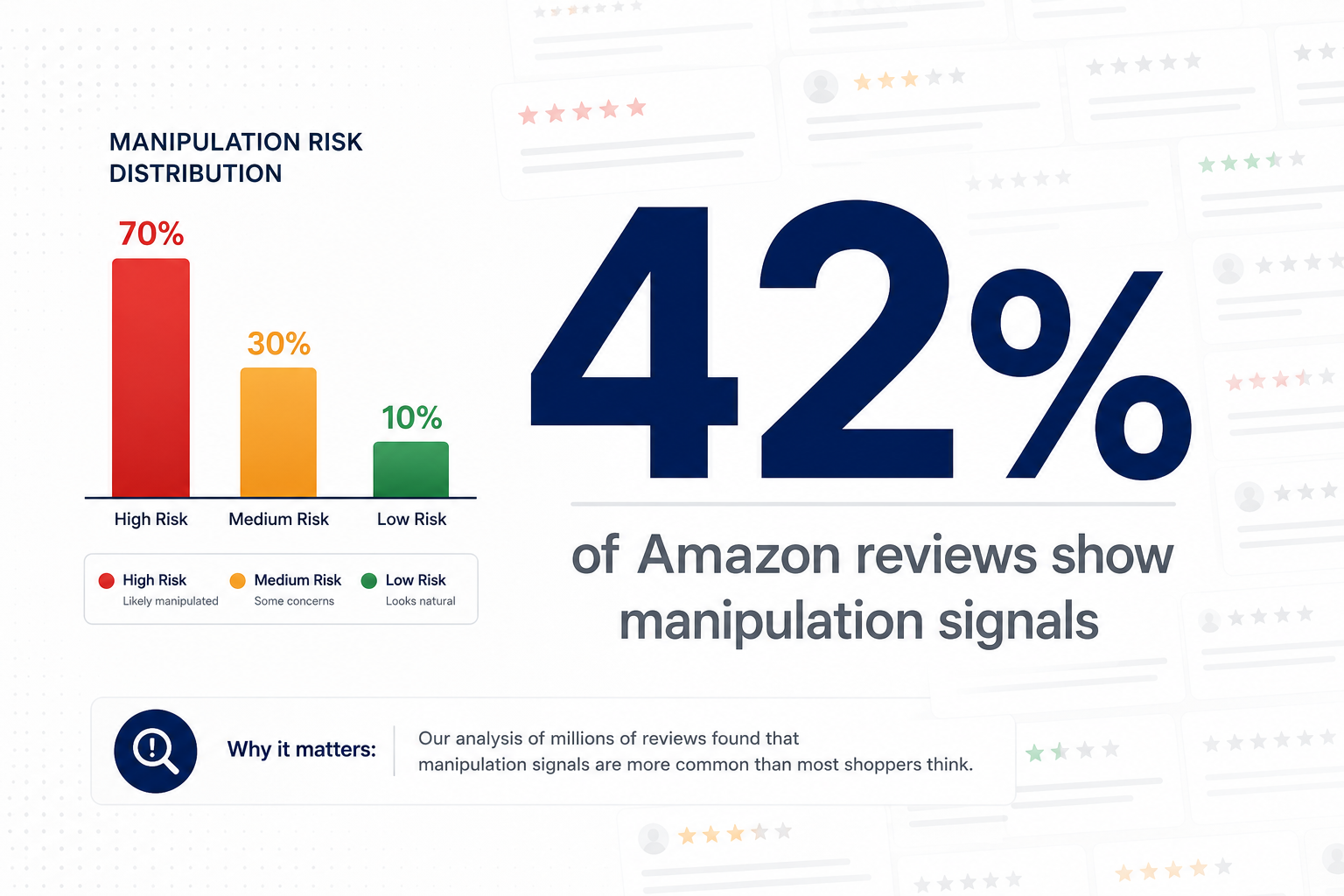
The number you'll see cited most often is somewhere between 30% and 42%.
That range comes from independent researchers, consumer advocacy groups, and analysis firms that scrape Amazon review data and apply statistical models to identify manipulation patterns. It gets quoted regularly. It probably sounds alarming — or maybe unsurprising, depending on how many times you've been burned.
Here's the problem with that number: it's a platform average. And platform averages hide the category-level reality that actually determines whether your specific purchase is at risk.
What the Research Actually Shows
Several independent studies have attempted to quantify Amazon's fake review problem. The methodology varies — some use linguistic analysis, some use network analysis of reviewer behavior, some cross-reference Amazon reviews with verified purchase data from other platforms — but the estimates land in a consistent band.
The platform-wide estimate: 30–42% of reviews showing manipulation signals.
Amazon's own enforcement data confirms that fake review operations remain widespread. In 2024, Amazon reported removing more than 250 million fake or fraudulent reviews. That number is probably an undercount, not an overcount.
What "manipulation signals" means in practice: reviews that show statistical patterns consistent with coordinated campaigns. Not necessarily every individual review is fake — but the pattern across a product's review set shows evidence of artificial intervention.
These estimates are based on detectable signals. AI-generated reviews that don't produce statistical fingerprints aren't captured in most research methodologies. The real percentage of manipulated reviews is likely higher than any current estimate can measure.
The Category Breakdown (Where It Actually Matters)
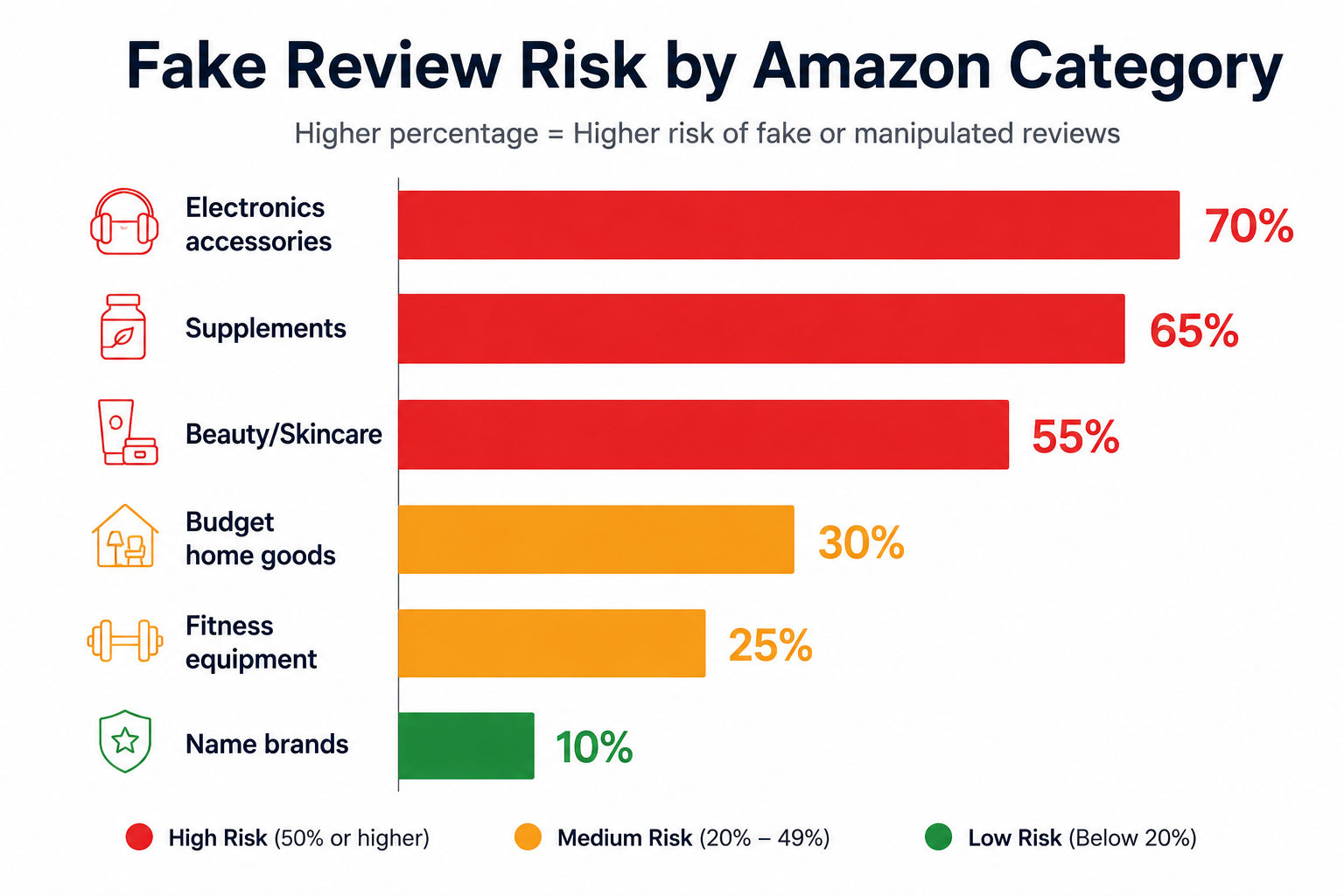
The platform average is almost meaningless for individual purchase decisions. What matters is the category you're shopping in.
High risk — estimated 50–70% manipulation rate:
- Electronics accessories ($10–$40): phone cases, cables, chargers, screen protectors, earbuds from unknown brands
- Dietary supplements and health products: weight loss, hair growth, testosterone support, nootropics
- Beauty and skin care: anti-aging serums, whitening products, hair treatment kits
These categories share a profile: high margin, repeat purchase potential, and claimed results that are hard to verify objectively. The return on investment for fake reviews here is high enough to support sophisticated, sustained campaigns.
Medium risk — estimated 20–35% manipulation rate:
- Budget home goods ($15–$60): kitchen gadgets, storage solutions, small appliances from unfamiliar brands
- Fitness equipment: resistance bands, workout accessories, yoga gear
- Pet accessories: toys, grooming tools, feeders
Lower risk — estimated 5–15% manipulation rate:
- Major name brands (Sony, Breville, Le Creuset, etc.) with established retail distribution
- Products with more than 5,000 reviews accumulated over multiple years
- High-ticket items ($200+) in categories like major appliances, power tools, and furniture
The pattern is consistent: manipulation concentrates where the margin per sale is high enough to justify the investment, and where claimed benefits are difficult for a casual buyer to verify before committing.
Why the Problem Got Worse in 2025–2026
The percentage of manipulated reviews increased in 2025 for a specific reason: the primary detection methods stopped working.
The tools shoppers relied on — Fakespot, ReviewMeta — were built to catch statistical patterns in review text and posting behavior. Velocity spikes. Identical phrasing. Accounts with no purchase history. These patterns were detectable because they were produced by human-coordinated campaigns that left fingerprints.
AI-generated review text doesn't leave those fingerprints. Each review is phrased differently. The timing is deliberate. The accounts posting them have legitimate histories. What was a detectable pattern in 2022 is now a baseline operating procedure for sophisticated review farms.
Fakespot shut down in July 2025. ReviewMeta hasn't meaningfully updated its methodology in years. The detection tools left the market at exactly the moment the problem became harder to solve.
What the Percentage Means for Your Specific Purchase
Here's the practical translation:
If you're buying a well-known brand — Sony headphones, KitchenAid appliances, established outdoor gear brands — the fake review risk is low. These brands have thousands of reviews from real customers, physical retail presence, and reputational incentives to maintain product quality.
If you're buying an unknown brand in a high-risk category — a $22 cable from a brand you've never heard of, a supplement with before-and-after photos in the listing — assume the review ecosystem is compromised until proven otherwise. The star rating tells you almost nothing.
If the product has the "Frequently Returned" badge — stop and investigate before deciding. This is Amazon's own signal, generated from return transaction data. It's harder to fake than a review and reflects post-purchase behavior from real buyers.
If there's no Reddit presence — search "[product name] reddit" for anything over $30. Real products get discussed. Absence of organic community discussion is itself a data point.
The Faster Alternative to Doing This Manually
Running this analysis manually takes time. A few minutes per product, if you're doing it properly.
ReviewAI runs the same analysis in 10 seconds. Paste any Amazon URL and get a BUY, SKIP, or CAUTION verdict with the reasoning shown: review trust score, deal breakers, community signal from Reddit and YouTube, and the specific factors that drove the recommendation.
The fake review percentage doesn't matter much for your individual purchase. What matters is whether this specific product's review ecosystem is trustworthy enough to inform your decision.
Stop guessing. Get an AI verdict on any Amazon product in 10 seconds.
Try it free →Published by the ReviewAI team · July 2026
Ready to test it on a real Amazon product?
Stop guessing if reviews are legit. Get an instant, AI-powered BUY or SKIP verdict on any Amazon product before you checkout.
Try Live Demo