How to Detect Fake Amazon Reviews in 2026 (Before They Cost You Money)
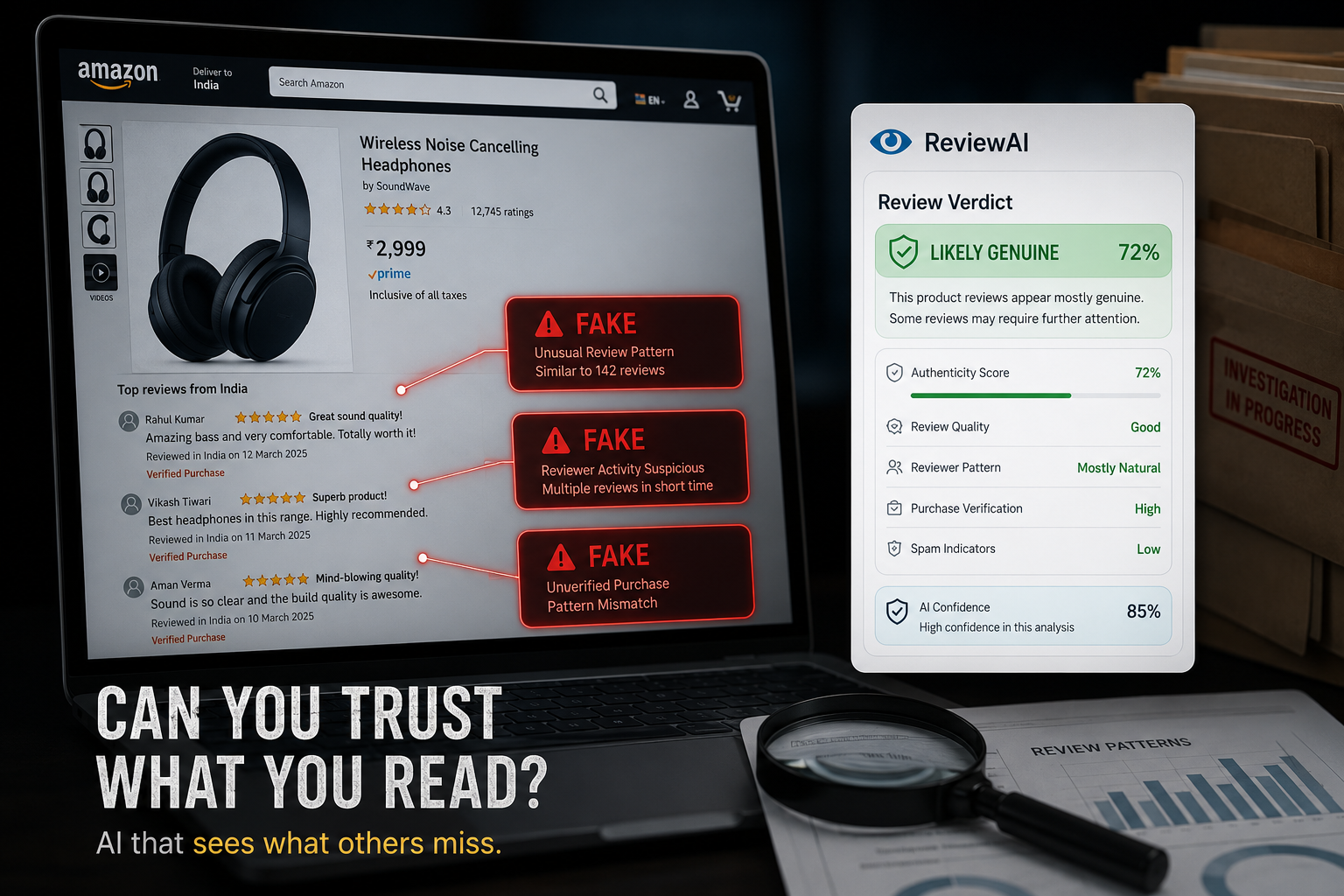
How to Detect Fake Amazon Reviews in 2026 (Before They Cost You Money)
Something shifted in 2025 that most shoppers haven't caught up with yet.
The tools that used to protect you from fake Amazon reviews stopped working. Not because the developers gave up — because the tactics evolved past them. Fakespot caught letter-grade fraud from 2019. It couldn't catch a GPT-4 review written by an account with a three-year purchase history and 47 prior reviews on unrelated products.
This guide is the updated playbook. What the old signals were, where they still matter, what replaced them, and how to get a confident verdict on any Amazon product in under five minutes — or 10 seconds with AI.
Why Fake Review Detection Got Harder in 2026
The fake review industry industrialized. That's the honest summary.
What existed before was clunky: Facebook groups recruiting participants, insert cards in packages, offshore accounts with obvious patterns. Detectors like Fakespot and ReviewMeta were built to catch exactly that — statistical anomalies, identical phrasing, velocity spikes, reviewer profiles with no purchase history.
Then two things happened simultaneously.
First, AI-generated review text got good. Not "good enough to fool a casual reader" — good enough to fool linguistic analysis tools. Reviews that mention specific product details. Reviews that vary in length, tone, and structure. Reviews that describe real-sounding personal experiences in first person. Generated by a model, posted by an account with legitimate history, marked Verified Purchase because someone actually bought the product first.
Second, the infrastructure professionalized. What used to be coordinated Facebook groups became organized networks of aged accounts with real purchase histories, systematic campaign management, and per-category writing briefs. The sophistication of the fraud scaled faster than the sophistication of the detection.
Fakespot shut down in July 2025. ReviewMeta hasn't shipped meaningful updates in years. The two tools most people relied on are either gone or frozen while the problem they were built to solve has gotten significantly harder.

The Old Red Flags (That No Longer Work on Their Own)
These signals were reliable indicators of fake reviews from 2018 to roughly 2023. They're still worth noting — but none of them alone closes the case anymore.
Velocity spikes. A product getting 40 reviews in a week used to be a clear manipulation signal. Now, coordinated campaigns stretch posting over 4–6 weeks to flatten the curve. A slow drip of 6–8 reviews per week for a month doesn't trigger velocity alerts — but still represents a coordinated campaign.
Identical phrasing. The original Fakespot methodology leaned heavily on detecting similar language across reviews. AI-generated text specifically solves this problem. Each review is phrased differently, mentions different details, and varies in length and structure while hitting the same overall sentiment.
Reviewer account age and history. Single-review accounts were a flag. The current generation of operations maintains aged accounts with purchase history and a mix of legitimate reviews on other products. The account looks like a normal Amazon customer.
Five-star clustering. A product with 200 reviews and 190 five-stars was obvious. Now campaigns often include deliberate 3-4 star reviews in the mix — enough to avoid the obvious clustering pattern while keeping the overall average high.
None of this means the old signals are useless. They're still worth checking. They're just not sufficient on their own anymore.
What Actually Signals a Fake Review in 2026
The signals that hold up now are pattern-based, not individual-review-based.
Timing diversity — or the absence of it. Real organic reviews arrive randomly. One Monday, three the following Thursday, none for four days, then two more. Coordinated reviews — even when stretched over weeks — tend to have unnatural regularity. Same days of the week. Consistent volumes. The randomness of real human behavior is hard to fake at scale.
The 1-star review gap. A product with 400 reviews and zero specific, detailed 1-star complaints is suspicious. Real products fail. Real buyers complain with specificity — the exact failure mode, the exact timeline. When 1-star reviews are either absent entirely or universally vague ("disappointed, not worth the money"), something is off. Fake review campaigns that plant 3-4 star reviews usually don't bother generating realistic negative reviews.
No Reddit presence. Search "[product name] reddit" for anything you're considering. Real products get discussed organically — complaints, recommendations, troubleshooting threads. A product with 600 Amazon reviews and zero Reddit presence is a flag. Community discussion is much harder to manufacture than a listing review.
Specific failure timing. Across a product's legitimate 1-star reviews, look for failure at a consistent point in the product's lifecycle. "Stopped working after 3 months" appearing across five different reviewers from different time periods is a product reliability issue, not coincidence.
The "Frequently Returned" badge. Amazon's own signal, generated from return transaction data that sellers can't manipulate. When it appears, a statistically significant number of buyers returned this specific product. This is often more reliable than any review analysis because it reflects post-purchase behavior, not pre-purchase statements.
The Five-Minute Manual Check
When you're willing to spend five minutes on a purchase decision, here's the sequence that works.
1. Check for the "Frequently Returned" badge first. Before reading a single review, look for it in the product attributes below the main images. If it's present, go straight to the most recent 1–2 star reviews and read for the reason.
2. Sort by Most Recent, read the last 20 reviews. You're evaluating the product you're about to buy — not what it was two years ago. Sellers change manufacturers, reformulate products, switch suppliers. Recent reviews reflect what you're actually getting.
3. Filter to 1-star and 2-star, look for patterns. Not individual complaints — patterns. The same failure described by multiple reviewers across different time periods is product signal. Vague 1-star reviews with no specific details are suspicious either way.
4. Check review timing in the Most Recent view. Scroll through and look for regularity — reviews arriving on suspiciously similar schedules, especially on a relatively new product.
5. Search Reddit. "[product name] reddit" or "[brand name] problems reddit" — two minutes maximum. Genuine community discussion is the strongest authenticity signal available.
Stop guessing. Get an AI verdict on any Amazon product in 10 seconds.
Try it free →Old Method vs. ReviewAI: What the Analysis Looks Like Now
The shift from Fakespot's letter grade to a full AI verdict isn't cosmetic — it's a fundamentally different approach to the same problem.
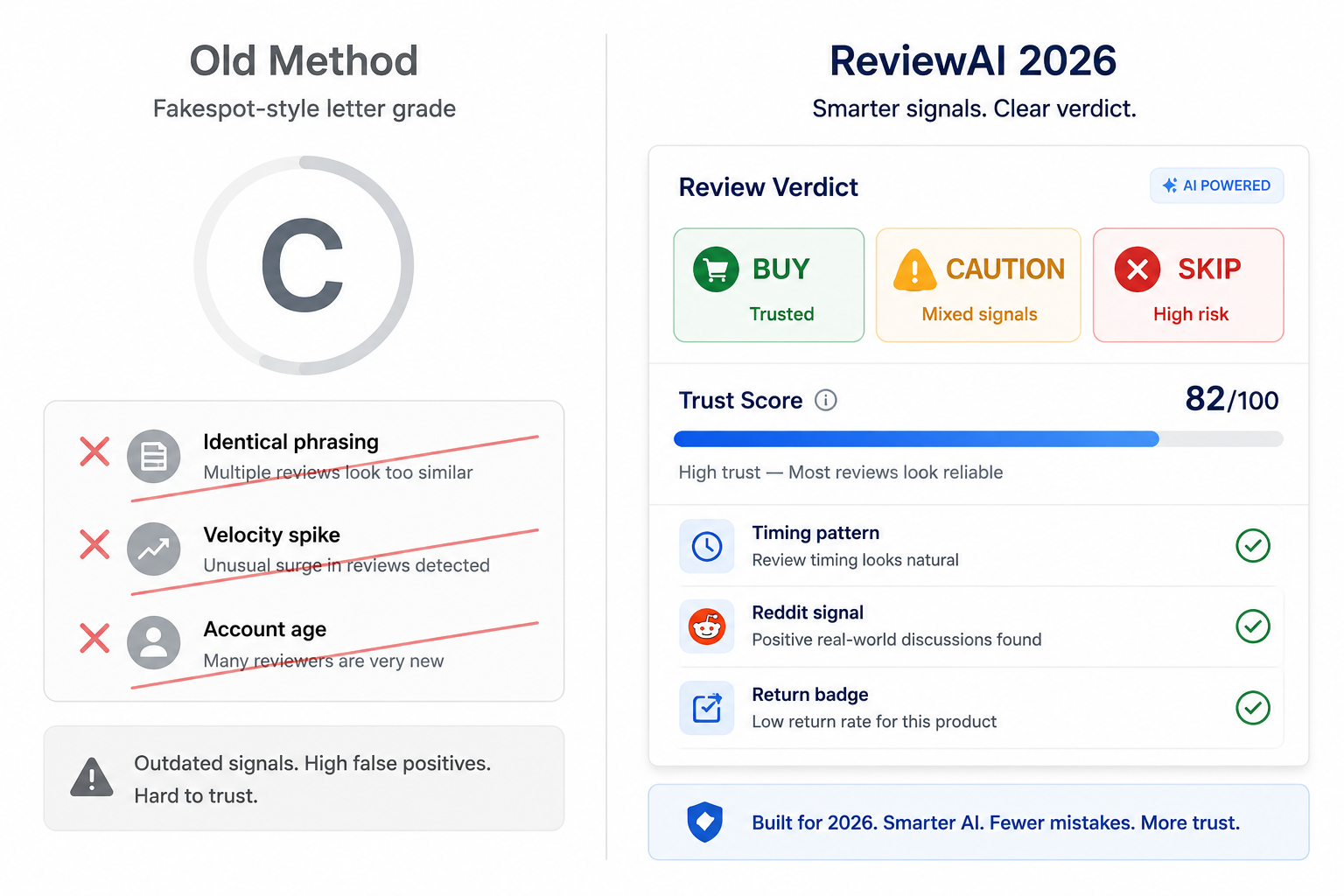
Fakespot gave you a letter grade. B+. C. That told you the review quality score was lower than the star rating implied — but left the actual decision entirely to you. Was a B+ good enough to buy? Was a C a skip? You still had to judge.
ReviewAI skips the grade entirely and returns a verdict: BUY, SKIP, or CAUTION, with the specific evidence that drove it listed in plain English. Deal breakers (recurring failure modes, the return badge, negative Reddit threads) are called out directly. The trust score tells you how confident the AI is based on review volume and consistency.
The difference matters most under time pressure. A letter grade at 11pm while you're deciding whether to add something to your cart doesn't close the decision. A verdict does.
The Categories Where Fake Reviews Are Worst
Not all Amazon categories have the same fake review density. Knowing which to apply extra skepticism saves time.
Electronics accessories ($10–$40 range): Cables, chargers, phone cases, screen protectors. The highest concentration of manipulated reviews on the platform. Low manufacturing cost, high volume, easy to flood with coordinated reviews.
Dietary supplements and health products: High-margin, repeat-purchase products attract sophisticated review manipulation. The FTC has taken action against multiple brands in this category.
Beauty and skincare ($15–$60): Significant manipulation, particularly in whitening, anti-aging, and hair growth categories where claimed results are hard to verify objectively.
Budget kitchen appliances ($20–$80): Products from unknown brands with 4.5+ star averages and high failure-rate categories — air fryers, electric kettles, blenders — frequently show the Frequently Returned badge alongside inflated ratings.
Established name brands in any category: Generally more reliable. The manipulation risk drops significantly for products from brands with existing retail distribution and reputation to protect.
Published by the ReviewAI team · July 2026
Ready to test it on a real Amazon product?
Stop guessing if reviews are legit. Get an instant, AI-powered BUY or SKIP verdict on any Amazon product before you checkout.
Try Live Demo