Fakespot vs ReviewMeta in 2026: Which Was Better (And What Replaces Both)
Fakespot vs ReviewMeta in 2026: Which Was Better (And What Replaces Both)
Two tools. Millions of users. Both essentially gone.
If you're still searching for whether Fakespot or ReviewMeta was better, you're probably looking for whichever one you didn't use — and hoping it still works. The honest answer is that neither one is what it used to be, and in 2026, neither methodology fully holds up anyway.
Here's the real comparison — what each tool actually did, where each one fell short, and what's actually worth using now.
Where Both Tools Stand Today
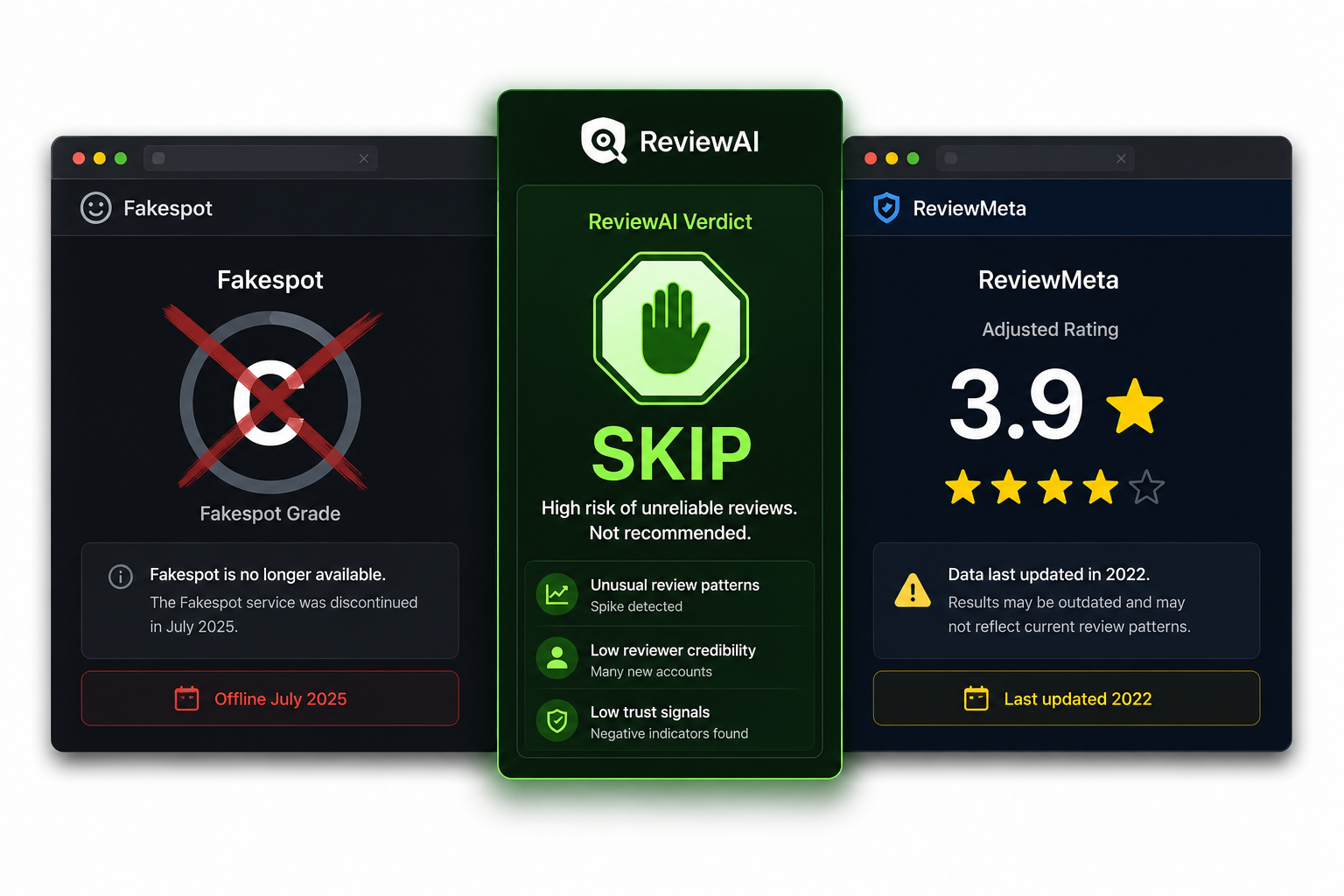
Fakespot: Offline since July 2025.
Mozilla discontinued the Firefox extension program that Fakespot depended on, and the parent company shut down the consumer product entirely. The Chrome extension, web tool, and iOS app are all gone. Nothing is available for download or use.
ReviewMeta: Technically alive, functionally stagnant.
ReviewMeta's website still loads. You can still paste an Amazon URL and get an adjusted rating. But the tool hasn't shipped a meaningful update since 2022, and the underlying methodology hasn't kept pace with how Amazon's fake review problem has evolved. It's not dead — it's just frozen at a moment in time when the problem was significantly simpler than it is now.
What Each Tool Was Actually Built To Do
Understanding the comparison requires understanding what each tool was actually solving for.
Fakespot was built around a browser extension workflow. Install it, shop on Amazon normally, and Fakespot would grade the product's reviews in the background — A through F — as you browsed. The grade was based on a proprietary algorithm that looked for velocity spikes, reviewer account characteristics, and linguistic patterns associated with coordinated review campaigns.
The integration was Fakespot's strength. You didn't have to go anywhere. It became a habit — you'd look for the badge before trusting anything. At its peak, millions of users had it installed.
ReviewMeta took a different approach: statistical de-skewing. Paste a product URL into the ReviewMeta website, and it would re-weight the reviews — filtering out the ones its algorithm flagged as suspicious — and return an "Adjusted Rating." Instead of a 4.7, maybe you'd get a 4.1. It was transparent about which reviews it removed and why, which built genuine trust among power users.
ReviewMeta required more deliberate use than Fakespot — you had to remember to check it — but its methodology was more visible and its output was more granular.
Head-to-Head: The Honest Comparison
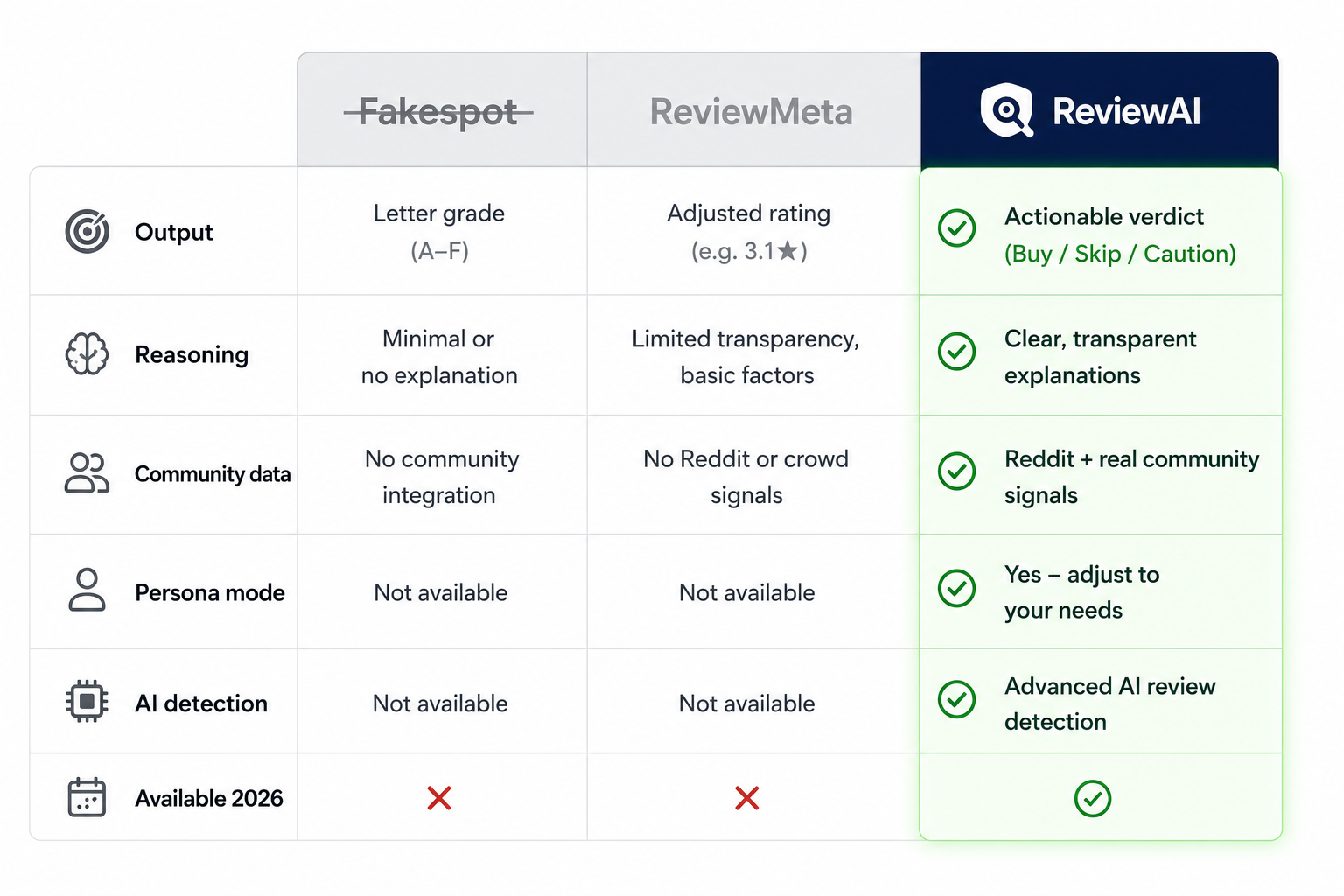
Both tools had the same fundamental limitation: they gave you a quality signal, not a decision.
A Fakespot C grade tells you the reviews are suspicious. It doesn't tell you whether to buy the product. A ReviewMeta 3.9 adjusted rating tells you the true score is lower than listed. It doesn't tell you if 3.9 is good enough for what you need.
That gap — between a signal and a verdict — is where both tools fell short, and it's why neither one was ever as satisfying as it should have been.
Why Neither Would Work in 2026 Anyway
Even if both tools were still fully operational, they'd be fighting a problem they weren't built for.
Both Fakespot and ReviewMeta were designed to detect the review fraud of the 2018–2022 era: coordinated campaigns with velocity spikes, repetitive phrasing, accounts with obvious review patterns. Those tactics were effective and detectable because they were statistically visible.
What's operating now is different. AI-generated review text doesn't repeat phrases. It doesn't cluster in obvious timing windows. It mentions product-specific details convincingly. It comes from accounts with years of legitimate purchase history and a realistic mix of reviews on other products. The statistical fingerprints that Fakespot and ReviewMeta were calibrated to find are no longer reliably present.
Catching AI-generated fake reviews requires evaluating the substance of a review — does it describe specific experience that a real person would have? — not just its statistical properties. That requires a fundamentally different type of analysis.
What Actually Replaces Both
ReviewAI was built to do what Fakespot and ReviewMeta couldn't: give you an actual purchase decision, not a grade.
The goal was never a better grade. The goal was always a confident answer to one question: is this worth buying?
Stop guessing. Get an AI verdict on any Amazon product in 10 seconds.
Try ReviewAI free →Published by the ReviewAI team · July 2026
Ready to test it on a real Amazon product?
Stop guessing if reviews are legit. Get an instant, AI-powered BUY or SKIP verdict on any Amazon product before you checkout.
Try Live Demo