ReviewMeta Alternative in 2026: The New Standard for Amazon Review Checking
ReviewMeta Alternative in 2026: The New Standard for Amazon Review Checking
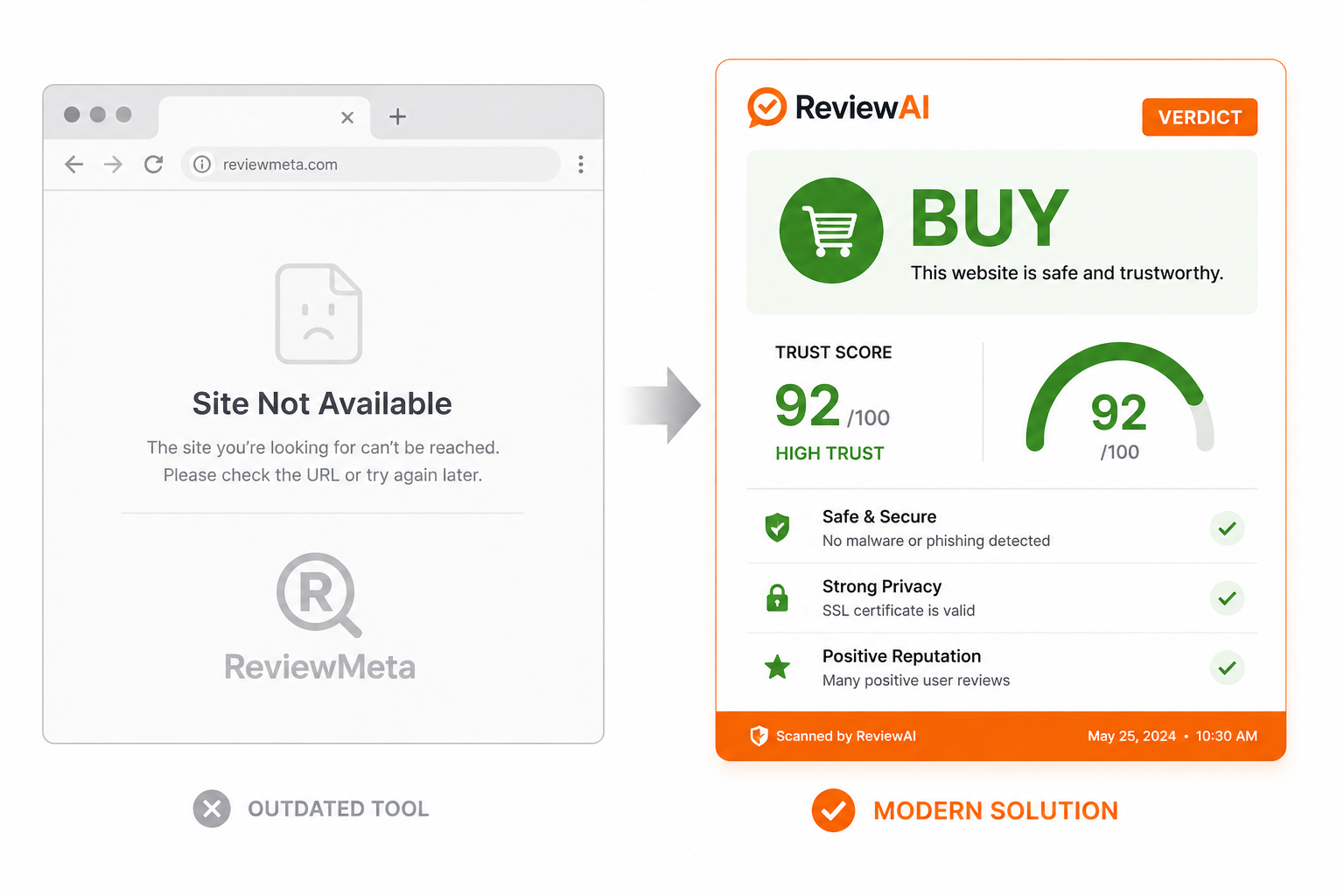
Quick Answer: ReviewMeta went offline in early 2026. The best ReviewMeta alternative is ReviewAI, which delivers a BUY/SKIP/CAUTION verdict in 10 seconds, cross-references Amazon reviews with Reddit and YouTube, and adjusts its analysis based on your buyer persona. It's not just a replacement. It's an upgrade.
If you're here, you've probably noticed that ReviewMeta isn't working anymore. The de-skewing tool that corrected for suspicious review patterns is gone. This isn't a temporary outage — it's a permanent shutdown.
The need it served — making sense of manipulated Amazon reviews — hasn't gone anywhere. If anything, it's more urgent. AI-generated fake reviews have made the problem harder to solve, and the old methods aren't keeping up.
This post will walk you through exactly what happened to ReviewMeta, what's changed in the world of review analysis, and which tool you should switch to now.
What Happened to ReviewMeta?
ReviewMeta was the standard for a specific kind of analysis. You would paste an Amazon URL, and it would re-weight the reviews, filtering out the ones its algorithms flagged as suspicious. It would give you an "Adjusted Rating" — a star score that was often lower than the one on Amazon.
It was transparent, widely trusted, and effective for its time. The problem wasn't that it failed. The problem was that review manipulation tactics evolved until its core methodology became obsolete. ReviewMeta's engine was designed to spot the review fraud of the 2019–2022 era — coordinated Facebook groups, obvious velocity spikes, and repetitive phrasing. It couldn't keep up with the new wave of AI-generated review farms.
A tool built to remove statistical noise couldn't filter out reviews that were indistinguishable from an honest, articulate customer.
What ReviewMeta Did Well (And Where It Always Fell Short)
To understand what a real replacement needs to do, it's worth being honest about both sides.
What It Did Well:
- Transparency: It didn't just give you a score. It showed you which reviews it removed and why. This built immense trust.
- Star Re-calibration: For products with obvious review manipulation, the adjusted rating was a far more honest signal than the raw Amazon average.
- Simplicity: Paste a link, get an adjusted rating. No account, no paywall.
Where It Always Fell Short:
- It only gave you a grade, not a decision. A 4.1 adjusted rating instead of 4.7 is useful, but it still leaves you asking "...so should I buy this?"
- No category context. A high adjusted rating on a $10 phone case means something very different from the same rating on a $300 appliance.
- No community data. The real verdict on a product's longevity often lives on Reddit or YouTube. ReviewMeta never looked outside the Amazon bubble.
- Slow and not mobile-friendly. Most Amazon browsing happens on phones. ReviewMeta wasn't built for that.
ReviewMeta's core limitation wasn't its accuracy — it was that a cleaned-up star rating still isn't a verdict. Shoppers need a decision, not a number.
Why a Simple "Adjusted Rating" Isn't Enough in 2026
The Amazon review landscape has fundamentally changed. You're no longer just dealing with obvious fake reviews. You're dealing with something more insidious: perfectly written, grammar-error-free, 200-word reviews from accounts with a normal purchase history, generated by large language models at scale.
These reviews don't have statistical ticks. They don't use the same words. They don't all appear in a one-week burst that would trigger a velocity filter. Counting pronouns and checking for similar phrasing — the kind of analysis ReviewMeta was built on — can't catch them.
You need an AI to catch an AI.
This is the core reason ReviewAI's approach is fundamentally different from de-skewing a star rating. Google's Gemini 2.5 Flash model doesn't just look for statistical anomalies — it evaluates the substance of each review for signs of real, personal experience, and cross-references patterns across the full review set.
The question has shifted. It's no longer "Is the average rating accurate?" It's "Based on all available honest information, should I buy this product for my needs?" Answering that requires more than math.
ReviewAI vs. ReviewMeta: A Feature Comparison
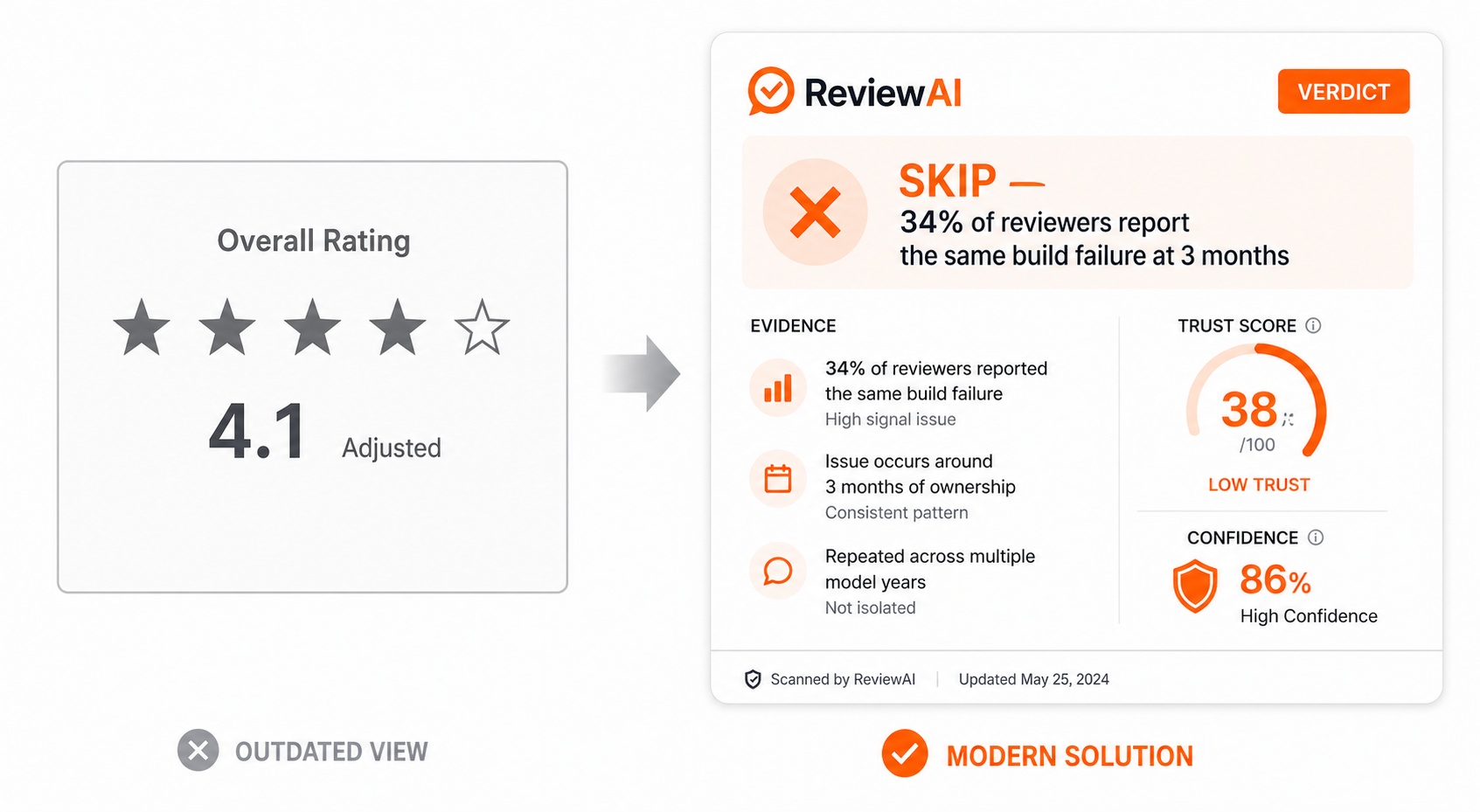
An adjusted rating tells you the star score is probably a lie. A verdict tells you what to do about it.
How to Use ReviewAI as Your New Default
The workflow takes less than 15 seconds.
- Find a product on Amazon you're considering.
- Copy the URL from your address bar.
- Go to reviewai.pro and paste the URL.
- Read your verdict:
- The verdict card tells you in two sentences whether to BUY, SKIP, or CAUTION.
- The Trust Score shows how authentic the reviews are. The Confidence Score shows how much evidence supports the verdict.
- The Deal Breakers section flags any critical, recurring problems immediately.
- For deeper analysis: Choose a buyer persona (Durability Focused, Gift Buyer, etc.) to re-calibrate the verdict to your specific priorities.
Try ReviewAI free on your next Amazon purchase
Try ReviewAI FreeFor purchases over $50, the Pro plan unlocks the Community Signal layer — automatically surfacing relevant Reddit threads and YouTube reviews right on your report. Multiple verified data points outside Amazon's ecosystem, no manual searching required.
The Bottom Line
ReviewMeta was a great tool for its era, but that era is over. The current challenge isn't cleaning noise out of a star rating. It's distinguishing AI-generated fluff from genuine human experience and synthesizing that into a clear, confident purchase decision.
The replacement you need isn't just about fixing a broken rating. It's about answering the one question you actually have: "Is this worth buying?"
Try ReviewAI for free on your next Amazon purchase →
Related: Best Amazon Review Checker Tools in 2026 · Can You Trust Amazon Reviews in 2026? · How to Use AI to Check Amazon Reviews
Ready to test it on a real Amazon product?
Stop guessing if reviews are legit. Get an instant, AI-powered BUY or SKIP verdict on any Amazon product before you checkout.
Try Live Demo