Blog/Amazon Insights

Can You Trust Amazon Reviews in 2026? The Complete Truth (With Data)
R
ReviewAI Team
E-commerce Research Team
Published2026-03-10

Can You Trust Amazon Reviews in 2026?

Can You Trust Amazon Reviews in 2026? The Honest Answer

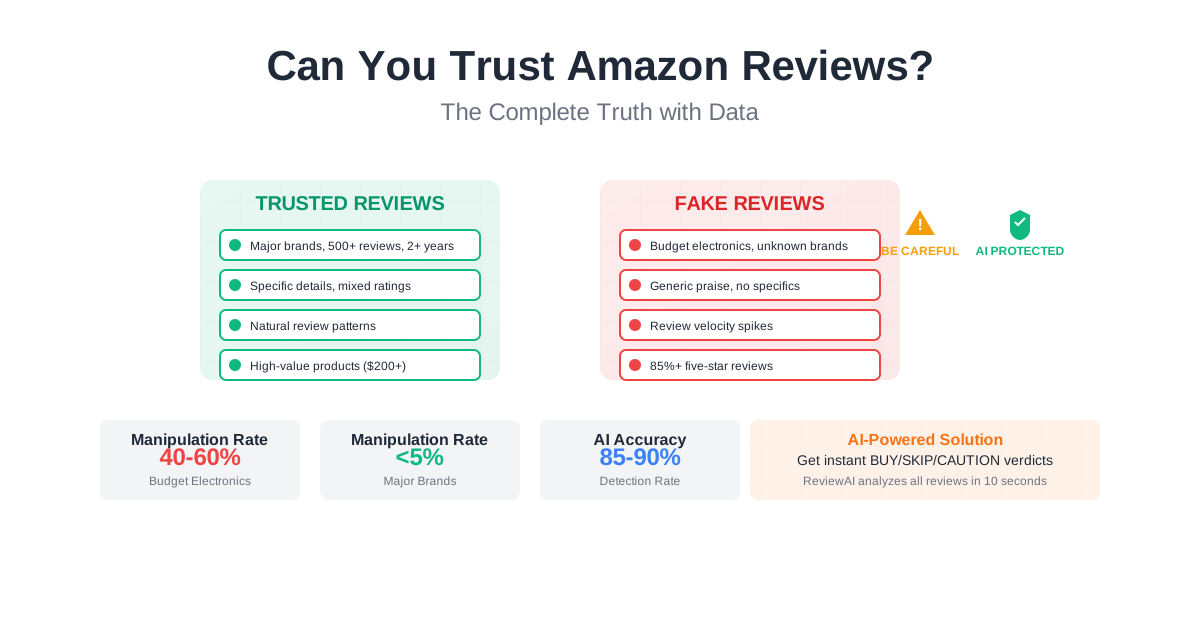
Quick Answer: Amazon reviews are selectively trustworthy. Major brands with 500+ reviews over 2+ years are reliable. Budget electronics, supplements, and generic home goods have high manipulation rates. AI analysis now provides better purchase guidance than star ratings alone.

The answer is: it depends, and the nuance matters more than most people realize.

If you're looking for a simple yes or no, you won't get one here — because the real answer is more useful than either. Amazon reviews in 2026 are a complex ecosystem. Some categories are relatively trustworthy. Others are chronically manipulated. And the patterns that separate reliable reviews from manufactured ones are learnable.

This guide gives you the full picture: how the problem has evolved, where it's worst, what Amazon is doing about it, and how AI is changing the equation for buyers.

How Amazon's Review Problem Has Evolved: 2020 to 2026

Amazon's fake review problem isn't new. But it has changed significantly in both scale and sophistication over the past six years.

2020-2021: The Facebook Group Era

The most prominent manipulation method of this period was the seller-incentivized review Facebook group. Sellers would invite buyers to join private groups, offer free products in exchange for reviews, and coordinate campaigns to flood listings with 5-star ratings. These groups were large, organized, and remarkably effective.

What happened:

  • Groups had 50,000+ members coordinating review campaigns
  • Sellers offered full refunds after "honest" reviews (wink wink)
  • Amazon identified and banned hundreds of thousands of reviews
  • Meta shut down major groups after regulatory pressure

The problem didn't disappear — it moved underground and became harder to detect.

2022-2023: The Review Mill Era

As the Facebook group approach became higher risk, the industry shifted to professional review services — essentially paid review farms that used networks of verified accounts to leave reviews that looked organic.

Characteristics:

  • More expensive but more sophisticated operations
  • Used VPNs, varied purchase histories, time-delayed submissions
  • Amazon responded by deleting tens of millions of reviews
  • High-profile lawsuits against review brokers made news

But the volume of the professional review industry meant enforcement was effectively playing whack-a-mole.

2024-2025: The AI-Assisted Manipulation Era

The current version of the problem is harder to detect than anything that came before. AI-generated review text is now common at scale — reviews that read naturally, vary in length and tone, and are difficult to distinguish from genuine human experience.

What's different now:

  • AI writes reviews that pass basic authenticity checks
  • Reviews include specific product details and varied experiences
  • Manipulation campaigns are smaller but more targeted
  • Detection requires sophisticated AI analysis to identify

Simultaneously, AI-powered detection tools — including the kind of analysis reviewai.pro uses — have also improved. The arms race between manipulation and detection is ongoing, and detection is improving faster than manipulation.

2026: The Current State

Amazon's review landscape in 2026 is not uniformly untrustworthy. It's selectively untrustworthy in predictable ways. Understanding which categories and signals to trust — and which to discount — is a learnable skill.

Which Categories Are Most Affected (And Least Affected)

Review Manipulation Rates by Category

Not all Amazon product categories have the same level of review manipulation. Understanding which categories carry more risk helps you calibrate trust appropriately.

🔴 Highest Manipulation Risk Categories

Budget Electronics and Tech Accessories ($10-$40 range)

Manipulation rate: ~40-60% of products show signs of review manipulation

This category has the highest incentive for review manipulation. Profit margins are thin, competition is intense, and the conversion lift from moving from a 4.0 to a 4.5 rating is significant in dollar terms.

Red flags to watch for:

  • Identical products under different brand names
  • Review spikes coinciding with price drops
  • Generic positive language lacking specific details

Phone Cases and Cables

Manipulation rate: ~50-70% of products

Virtually identical products compete on review count and rating alone. The cost of a review manipulation campaign is often lower than the return on a single additional sale.

What to look for instead:

  • Focus on recent reviews mentioning specific phone models
  • Check for "frequently returned" badge
  • Verify compatibility claims in Q&A section

Dietary Supplements and Beauty Products

Manipulation rate: ~30-50% of products

These categories have a specific manipulation pattern: early review campaigns that establish a strong rating, combined with product formulation changes after the listing is established.

Key warning signs:

  • Claims about health benefits in reviews
  • Before/after photos that look professional
  • Reviews that sound like marketing copy

Generic Home Goods from Marketplace Sellers

Manipulation rate: ~35-55% of products

Anything described as "premium quality" by an unrecognizable brand in the home goods category carries above-average review risk.

Protection strategies:

  • Check seller history and location
  • Look for specific use case details in reviews
  • Verify materials and dimensions match descriptions

🟢 Lowest Manipulation Risk Categories

Major Brand Products with Long Review Histories

Manipulation rate: Less than 5% of products

A Samsung TV with 12,000 reviews accumulated over four years is not fake-reviewed. The volume and time span make coordinated manipulation impractical.

Why they're trustworthy:

  • Established brands have reputation risk
  • Large review volumes are expensive to manipulate
  • Long time periods show authentic accumulation patterns

Books from Major Publishers

Manipulation rate: Less than 10% of products

Review manipulation exists in books (especially self-published ones), but the organic review base for well-established titles from major publishers is generally reliable.

Trust indicators:

  • Publisher recognition
  • Author track record
  • Editorial reviews from professional sources

High-Consideration Category Products ($200+)

Manipulation rate: ~15-25% of products

The conversion dynamics are different in high-value categories. Buyers do more due diligence, leave more detailed reviews, and are more likely to return products that don't match expectations.

Why manipulation is harder:

  • Buyers are more skeptical and thorough
  • Higher return rates expose quality issues quickly
  • Professional reviews and comparisons are common

Products with Significant Critical Review Content

Manipulation rate: Less than 20% of products

A product where a third of reviews are critical is unlikely to be heavily manipulated — incentivized reviews almost never include negative content.

Trust signal:

  • High volume of detailed critical reviews
  • Specific complaints about real product issues
  • Balanced distribution across star ratings

What Amazon Is (and Isn't) Doing About It

Amazon has made genuine efforts to address its review problem. The enforcement actions are real, the policy updates are substantial, and the investment in detection technology is significant.

✅ What Amazon Has Done

Massive review deletions:

  • Deleted hundreds of millions of suspected fake reviews since 2020
  • Removed entire seller accounts for review manipulation
  • Implemented machine learning detection systems

Legal enforcement:

  • Sued dozens of review brokers and fake review services
  • Won significant judgments against manipulation networks
  • Pursued international enforcement actions

Policy improvements:

  • Banned incentivized reviews (free/discounted product exchanges)
  • Introduced "frequently returned" badge for high-return products
  • Enhanced verification requirements for reviewers

Technical improvements:

  • AI detection for coordinated review activity
  • Pattern analysis for suspicious reviewer behavior
  • Real-time monitoring of review velocity spikes

⚠️ Where the Limits Are

Structural constraints: Amazon is structurally limited in how aggressively it can enforce. The marketplace model means Amazon's revenue depends on the sellers whose behavior it's trying to police. Removing too many listings or suspending too many sellers creates business risk.

Reactive vs proactive enforcement: Amazon's enforcement has historically been reactive rather than proactive. Reviews are typically removed after complaints and escalation rather than before the manipulated reviews go live.

Scale challenges: With millions of products and reviews added daily, even sophisticated AI detection can't catch everything in real-time. Successful manipulation campaigns can achieve their goals before detection occurs.

The "frequently returned" flag limitation: This is one of Amazon's most useful honest signals, but it only appears after significant return volume accumulates. New manipulated listings don't show it until damage to buyers is already done.

How AI Changes the Equation for Buyers

The evolution of AI-powered review analysis tools has meaningfully shifted the balance for buyers who use them.

Manual review reading, even done carefully, is difficult to scale and subject to cognitive bias — shoppers tend to read reviews that confirm the purchase they've already emotionally committed to. AI analysis doesn't have this problem.

What AI Review Analysis Does Better Than Humans

Pattern Recognition Across Large Review Sets

Human limitation: The average shopper reads 8-12 reviews before making a purchase decision. For a product with 400 reviews, that's 2-3% of the available evidence.

AI advantage: Processes all reviews simultaneously, identifies statistical anomalies in review timing and text patterns, surfaces recurring quality issues that no single reader would catch.

Category-Context Weighting

Human limitation: Shoppers need experience in each category to understand what ratings mean. A 4.4 rating means something different for budget Bluetooth headphones vs premium kitchen knives.

AI advantage: Trained on millions of products across categories, applies contextual understanding systematically without requiring personal experience in each category.

Recency Weighting Without Fatigue

Human limitation: Shoppers often read reviews in "Top Reviews" order, missing recent quality changes. When they do sort by recent, they get fatigued after 10-15 reviews.

AI advantage: Automatically weights recent reviews more heavily, identifies quality cliff patterns where recent reviews are materially worse than historical average.

Synthesis of Multiple Signals

Human limitation: Difficult to simultaneously consider star distribution, review text patterns, "frequently returned" status, review velocity, and category-specific risk factors.

AI advantage: Synthesizes all available signals into a single verdict with reasoning, like reviewai.pro's BUY/SKIP/CAUTION recommendations.

The Practical Framework: "Can I Trust This Specific Product?"

Here's the decision framework for evaluating any Amazon product's reviews:

🟢 Trust the Reviews When:

✅ Established brand with review history

  • 500+ reviews accumulated over 2+ years
  • Recognized brand name in the category
  • Review distribution includes some 1-2 star reviews (natural pattern)

✅ Natural review patterns

  • Recent reviews match historical tone and detail level
  • No suspicious review velocity spikes
  • Specific product details mentioned in reviews

✅ Quality signals present

  • No "frequently returned" badge
  • Detailed critical reviews that mention real product issues
  • Q&A section shows engaged seller responding to questions

🔴 Be Skeptical When:

⚠️ High-risk category + unknown brand

  • Budget electronics, supplements, generic home goods
  • Unrecognizable brand name or obvious private label
  • Product launched recently but has large review volume

⚠️ Suspicious review patterns

  • 85%+ five-star reviews (unnatural distribution)
  • Short, vague reviews that could apply to any product
  • Review spikes coinciding with price drops or promotions

⚠️ Warning signals present

  • "Frequently returned" badge visible
  • Seller doesn't respond to Q&A questions
  • Recent reviews significantly worse than historical average

🔍 Verify with AI When:

Use AI analysis for:

  • Any purchase over $30 where you're uncertain
  • Products in high-manipulation categories
  • Gift purchases where you can't easily return
  • When comparing multiple similar products

Get instant AI verdict →

Real-World Examples: Trust vs Skepticism

Example 1: Trust This Product

Product: Anker PowerCore 10000 Portable Charger

  • Brand: Established (Anker)
  • Reviews: 15,000+ over 3 years
  • Pattern: Natural distribution, detailed technical reviews
  • Signals: No "frequently returned" badge, specific compatibility mentions
  • Verdict: Reviews are trustworthy

Example 2: Be Skeptical of This Product

Product: "PREMIUM" Bluetooth Headphones ($25, unknown brand)

  • Brand: Generic/unknown
  • Reviews: 800 reviews in 6 months
  • Pattern: 90% five-star, generic positive language
  • Signals: Recent quality complaints, vague product descriptions
  • Verdict: High manipulation probability

Example 3: Verify with AI

Product: Kitchen Stand Mixer ($150, mid-tier brand)

  • Brand: Somewhat known but not major
  • Reviews: Mixed signals - good overall rating but some concerning recent reviews
  • Pattern: Unclear if recent complaints represent real issues or outliers
  • Action: Run through AI analysis for objective verdict

Frequently Asked Questions

How can I tell if a specific review is fake?

Look for generic language that could apply to any product, lack of specific details about actual use, and reviews that sound like marketing copy. Genuine reviews mention specific features, use cases, and often include minor complaints alongside praise.

Why doesn't Amazon just remove all fake reviews?

Amazon removes millions of fake reviews but faces scale challenges (millions of new reviews daily) and business constraints (aggressive enforcement could harm legitimate sellers). They balance detection accuracy with marketplace health.

Are incentivized reviews always fake?

Not necessarily fake, but they're biased. People who receive free products tend to leave more positive reviews. Amazon banned incentivized reviews in 2021, but some still slip through via external coordination.

How accurate is AI at detecting fake reviews?

Current AI systems (including reviewai.pro) are ~85-90% accurate at identifying manipulation patterns. They're much better than human analysis at scale but not perfect. Use AI as a powerful second opinion, not absolute truth.

Should I never buy products with suspicious reviews?

Not necessarily. Use suspicious reviews as a signal to investigate further. Check recent reviews, look for the "frequently returned" badge, and consider AI analysis. Sometimes good products have some fake reviews mixed with genuine ones.

What's the biggest red flag in Amazon reviews?

The "frequently returned" badge combined with recent negative reviews mentioning the same specific failure pattern. This indicates real quality issues confirmed by actual purchase and return data.

The Bottom Line: A Nuanced Answer

Can you trust Amazon reviews in 2026? Yes — selectively, with the right approach.

The star rating alone? No. Not without context.

The full picture — star distribution, recency trends, frequently returned signals, review patterns, and AI synthesis? That's actually more information than any previous generation of shoppers has had access to.

The irony of Amazon's review problem is that it's pushed consumers to develop better analytical tools. Fakespot built an audience of millions of people who'd learned to second-guess star ratings. AI tools like reviewai.pro are building on that habit with significantly more sophisticated analysis.

The practical approach:

  1. Quick check: Use AI analysis for instant verdict
  2. Category awareness: Higher skepticism for budget electronics, supplements, generic brands
  3. Signal verification: Check "frequently returned" badge and recent review patterns
  4. Trust but verify: Even good tools aren't perfect - use judgment for major purchases

See what AI sees in any product's reviews — reviewai.pro, free →


Stop guessing about Amazon review authenticity. Get AI-powered analysis of any product in 10 seconds. Paste any Amazon URL and get a clear BUY/SKIP/CAUTION verdict with reasoning.

Ready to test it on a real Amazon product?

Stop guessing if reviews are legit. Get an instant, AI-powered BUY or SKIP verdict on any Amazon product before you checkout.

Try Live Demo