Amazon Scam Checker: How to Verify Any Listing in 10 Seconds (Free)
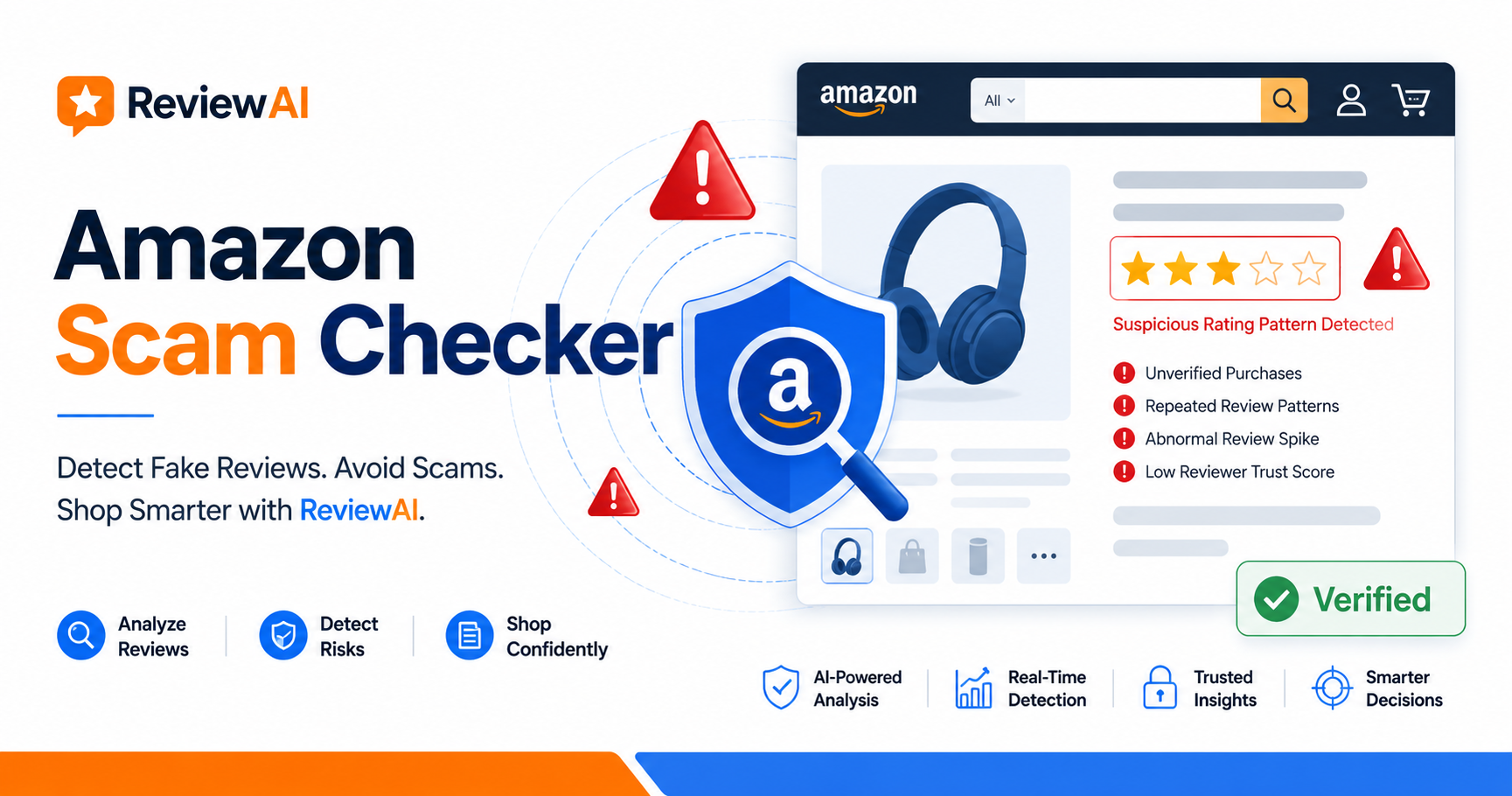
Quick Answer: The fastest free Amazon scam checker is ReviewAI. Paste any Amazon product URL at reviewai.pro and you get a trust score, a BUY/SKIP/CAUTION verdict, and a breakdown of exactly what triggered it — in under 10 seconds, no signup required.
If you want to understand what the checker is actually looking for, keep reading. The signals are worth knowing.
What "Amazon Scam" Actually Means in 2026
Not all Amazon scams are the same. The word covers several distinct schemes, each with its own detection signal:
Review fraud — Sellers pay for fake five-star reviews through cashback schemes, review swap groups, or AI-generated text farms. The product exists and ships, but the rating is manufactured.
Listing hijacking — A seller takes over a listing that already has thousands of genuine positive reviews — typically an old, discontinued product — and replaces it with an entirely different item. The reviews stay. The product changes. Shoppers who buy based on the rating receive something completely different.
Counterfeit products — Fake versions of branded goods sold under the original listing, often at a slight discount. Reviews are real but describe the genuine product, not the counterfeit being shipped.
Brushing — Sellers ship unsolicited cheap items to random addresses, then post verified-purchase reviews from the recipient's account without their knowledge. Creates a legitimate-looking review history.
Each type leaves different signals in the listing data. A real Amazon scam checker needs to look for all of them simultaneously.
The 5 Signals a Proper Amazon Scam Checker Analyzes
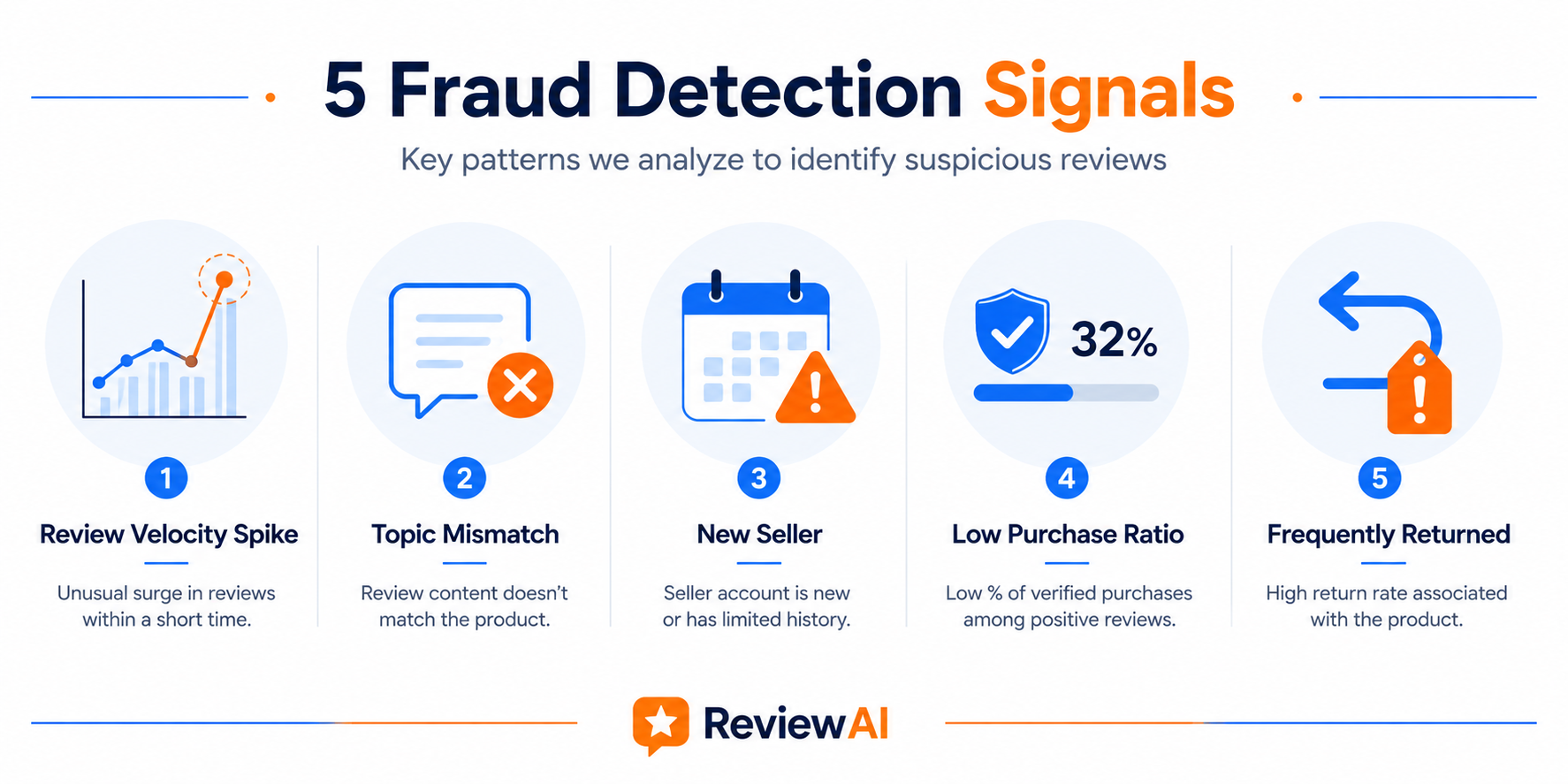
1. Review Velocity and Clustering
Authentic reviews trickle in over time, roughly proportional to sales volume. Scam operations produce bursts — hundreds of reviews posted in a single week, often from accounts created within days of each other. The pattern is visible in the review timeline even when individual reviews look convincing.
2. Review-to-Product Alignment
This catches listing hijacking. If the current product is a Bluetooth speaker but 40% of the reviews mention "the stitching" or "runs small," those reviews were written for a clothing item the listing used to sell. ReviewAI's language analysis compares review content against the current product's feature set and flags mismatches.
3. Seller Account Age and History
New seller accounts with high review counts are the most reliable scam signal on Amazon. A seller launched 60 days ago with 2,000 five-star reviews has either bought those reviews or is running a return-and-relist operation. Cross-reference the seller's other listings — a portfolio of generic, unrelated products under a generic store name is another red flag.
4. Verified Purchase Ratio
Amazon's "Verified Purchase" badge means the reviewer bought through Amazon at near-full price. Scam operations increasingly use real purchases — paying buyers to purchase and review — making this signal less reliable than it once was. But a product with fewer than 50% verified purchase reviews on a high-price item still warrants scrutiny.
5. The "Frequently Returned" Badge
Amazon only shows this badge when return rates are statistically abnormal for the category. It is Amazon's own signal that buyers who purchased based on the listing were disappointed enough to send it back. A product with inflated reviews and the Frequently Returned badge is the textbook scam pattern — the reviews overclaim, the product underdelivers.
The AI Review Problem
The shift to LLM-generated reviews has broken text-pattern detection. AI-generated reviews don't repeat phrases, don't cluster around five stars only, and include product-specific technical details that sound like personal experience. You need behavioral signals — account age, velocity patterns, verified purchase ratios — not just content analysis to catch them.
Manual Checking vs. AI Scam Checker: What Each Catches
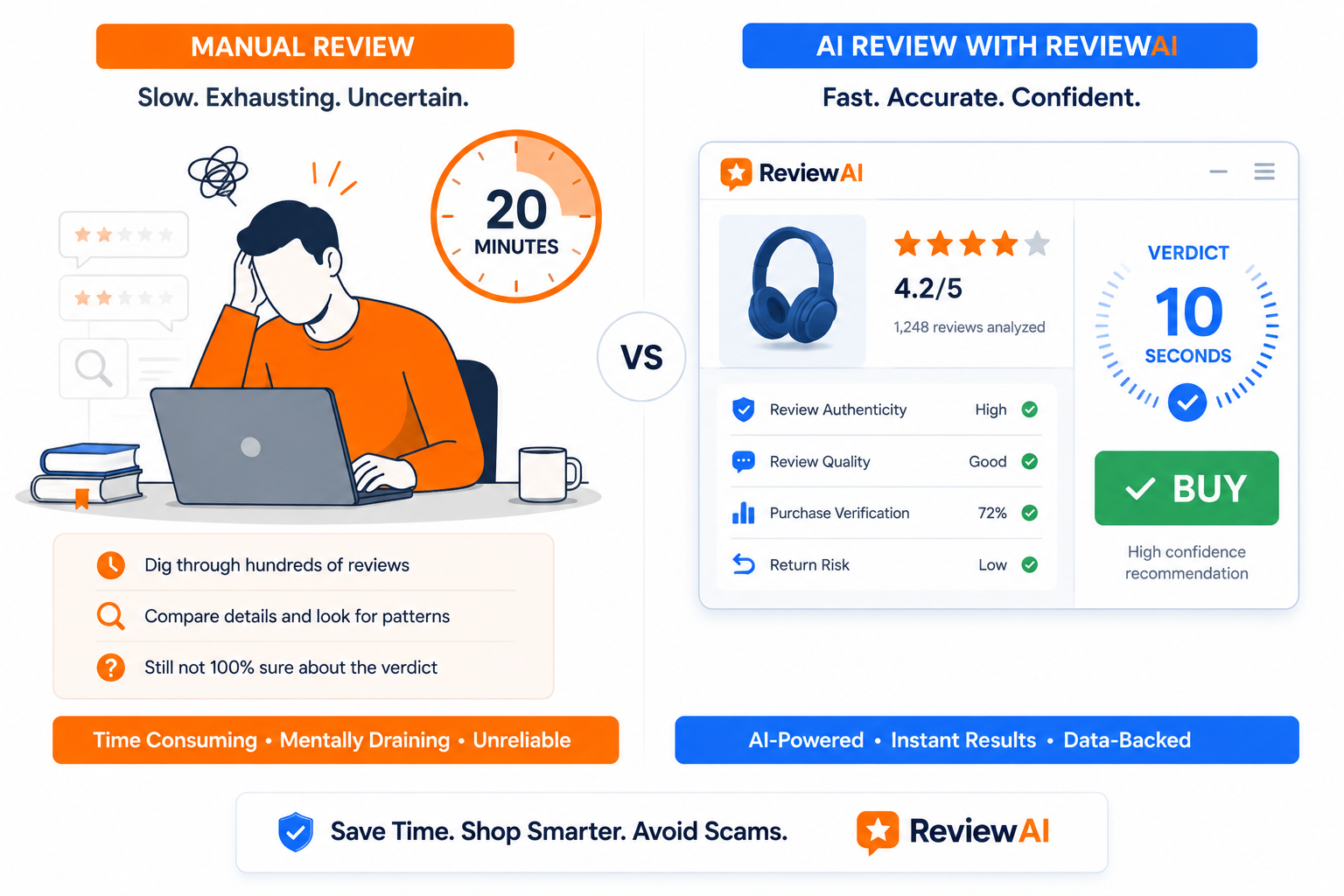
The practical gap for a single purchase isn't catastrophic. But if you're comparing three similar products or doing any volume of Amazon shopping, the manual approach doesn't scale.
How to Use ReviewAI as Your Amazon Scam Checker
Three steps:
1. Copy the Amazon product URL. Grab it from your browser's address bar on any Amazon product page. The full URL with the ASIN works — so does a shortened Amazon URL.
2. Paste it into ReviewAI. Go to reviewai.pro and paste the URL into the analyzer. No account required for up to 10 analyses per month.
3. Read the verdict. You get a trust score (0–100), a BUY/SKIP/CAUTION verdict, and a breakdown of the signals that drove it — including any flags for suspicious review patterns, listing anomalies, or community concerns from Reddit and YouTube.
The verdict is not a black box. If ReviewAI flags a product, you can see exactly which signals triggered it. If it gives a BUY verdict on a product you're skeptical about, you can see why — and decide whether to trust the analysis or dig deeper manually.
Check any Amazon product for scams in 10 seconds — free, no signup required.
Run a Scam CheckCommon Amazon Scam Patterns in 2026
The Vine Bait-and-Switch. Sellers join Amazon Vine to get legitimate verified reviews on a high-quality initial product batch, then swap the actual product shipped to regular buyers for a cheaper version. The Vine reviews remain attached to the listing.
The Review Inheritance Hijack. A seller purchases an old ASIN — often from a discontinued product with a clean review history — through a broker. Then they relist it under a new product name. The old reviews transfer. The new product has no genuine review history.
The Country-of-Origin Swap. A product listed with a prominent "Ships from US" badge actually fulfills from an overseas warehouse for most orders. The listing technically complies with Amazon's rules but misleads buyers about shipping times and return logistics.
The Fake Frequently Returned Workaround. Some sellers actively suppress the Frequently Returned badge by cycling through ASIN variations — creating new listings when return rates get too high. If a brand has multiple nearly-identical listings with slightly different ASINs, this is the likely reason.
What Amazon Is (and Isn't) Doing About It
Amazon's enforcement numbers are real: 250M+ suspected fake reviews removed in 2023, over 1,000 civil lawsuits filed against fake review networks since 2015, and the Transparency program that lets enrolled brands add per-unit QR codes to verify authenticity.
But the economics of enforcement are asymmetric. Amazon's third-party marketplace generated approximately $140 billion in 2023. Aggressive enforcement of borderline sellers imposes real revenue costs. The result is an enforcement posture that catches the obvious, unsophisticated fraud while the more sophisticated operations — the ones running listing hijacks and AI-generated review campaigns — operate in the gray zone.
This is exactly why a third-party scam checker that isn't commercially tied to Amazon's marketplace still matters.
Related Guides
Ready to test it on a real Amazon product?
Stop guessing if reviews are legit. Get an instant, AI-powered BUY or SKIP verdict on any Amazon product before you checkout.
Try Live Demo