Community Signal: ReviewAI's Reddit + YouTube Analysis Feature Explained
Community Signal: ReviewAI's Reddit + YouTube Analysis Feature Explained
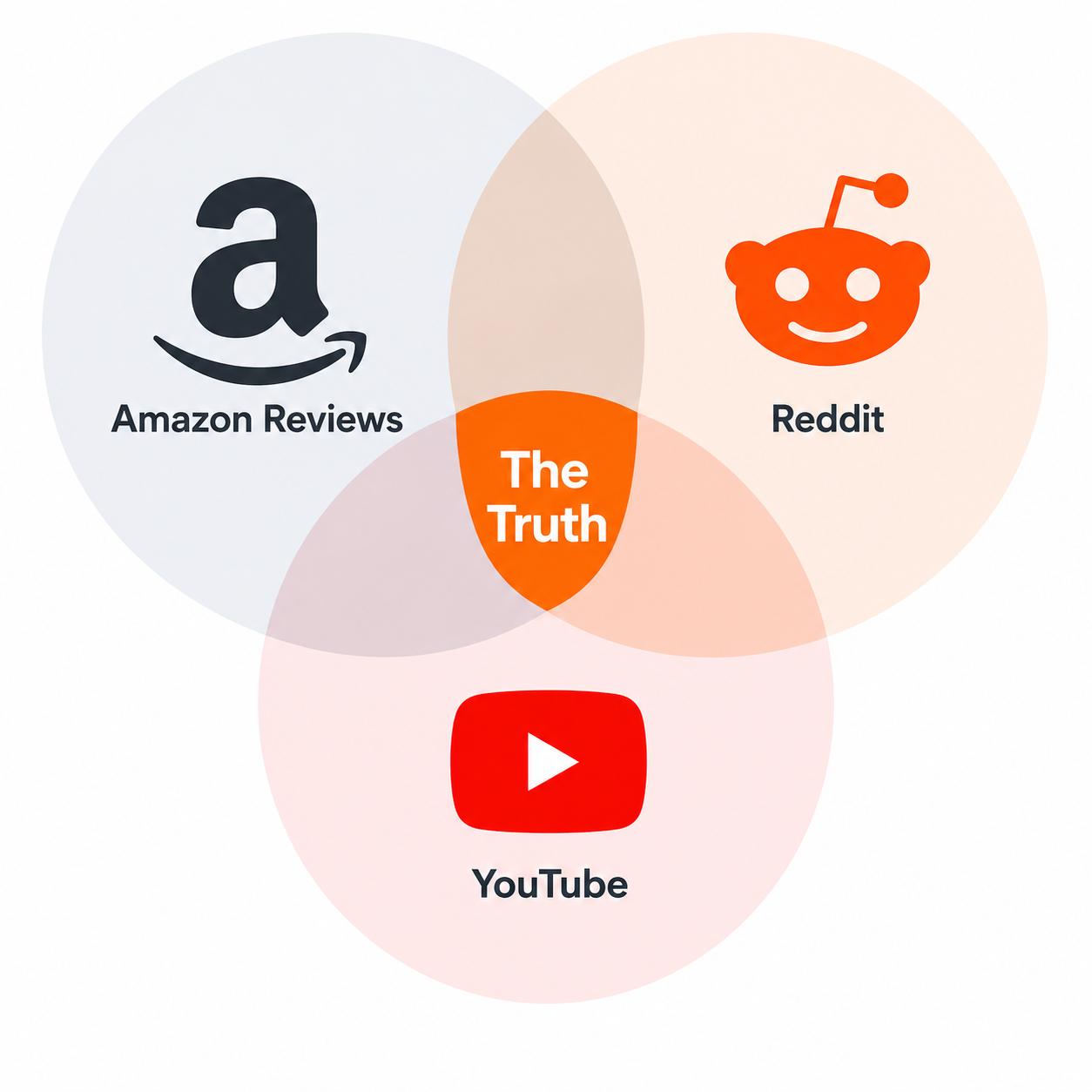
Quick Answer: Amazon reviews, Reddit threads, and YouTube videos each tell a different story about the same product. No single source gives you the full picture. ReviewAI's Community Signal is the only tool that automatically combines all three — so you see the consensus, the disagreements, and the hidden problems that no single platform reveals on its own.
You're considering a product. It has 4.5 stars and 1,200 reviews on Amazon. The top reviews are enthusiastic. The listing looks professional. The price is right.
On Reddit, someone who's owned the same product for eight months posted a detailed breakdown three weeks ago. The battery life degrades noticeably after about six months. Seven other people in the comments confirmed the same issue. That thread has 340 upvotes.
On YouTube, a creator with 200,000 subscribers reviewed the product four months ago. His unit arrived with a loose charging port. He showed it on camera. The comments section is full of people who had the same experience.
The Amazon page doesn't mention any of this. The Reddit thread doesn't appear in Google search results unless you know exactly what to search for. The YouTube video is buried under the official promotional content.
This is the core problem Community Signal solves. The most important product information exists — just not in the same place. And no other tool puts it together for you.
Why One Data Source Is Never Enough
Every review platform has a bias. Not because anyone is lying, but because the structure of each platform naturally selects for certain kinds of feedback and filters out others.
Amazon's structural bias: Reviews exist to help sell products. The platform's design — star ratings, verified purchase badges, helpfulness voting — is optimized to surface consensus, not nuance. A product with widespread but slow-developing problems can maintain a 4.5-star rating indefinitely because the people who discover the issue six months in rarely return to update their review.
Reddit's structural bias: Reddit selects for enthusiasm. The people who post about products are the people who care enough to post. This means Reddit feedback skews toward two extremes: products that are exceptionally good (worthy of a r/BuyItForLife post) and products that are exceptionally disappointing (worthy of a rant). The adequate middle ground gets less coverage.
YouTube's structural bias: YouTube reviews are influenced by access. Creators who receive review units from manufacturers are more likely to be positive, consciously or not. The sponsorship disclosure tells you something, but not everything.
None of these platforms is useless. None is fully trustworthy on its own. The value comes from comparing them — seeing where they agree, where they disagree, and what one platform knows that the others don't.
Amazon vs. Reddit vs. YouTube: What Each Platform Is Actually Good At
The pattern is clear: each platform covers the weaknesses of the others. The Reddit thread catches the long-term battery issue that Amazon reviews miss. The YouTube video confirms the build quality that Reddit commenters describe. The Amazon review set provides the volume that validates whether a Reddit complaint is a one-off or a pattern.
The problem isn't that any of these sources are bad. The problem is that manually checking all three is slow — and nobody does it.
The Manual Process vs. Community Signal
Here's what it takes to do this yourself for a single product:
- Sort Amazon reviews by Most Recent, read 20–30 looking for pattern complaints (5 min)
- Search Reddit for the product name across relevant subreddits, read the top threads (10 min)
- Find a credible YouTube review from an independent creator, watch enough to assess the verdict (10 min)
- Cross-reference all three sources to form a conclusion (5 min)
Total: 30 minutes. For one product. For three products you're comparing, that's 90 minutes. Most shoppers don't do it — they read eight Amazon reviews and hope for the best.
Community Signal automates this entire process. When you analyze an Amazon product URL, the system runs all three searches in parallel:
- Amazon reviews are scraped and analyzed for pattern complaints, star distribution anomalies, and authenticity signals
- Reddit's public API is queried for threads mentioning the product, filtered for engagement (5+ upvotes), and summarized via AI to extract the consensus and recurring themes
- YouTube's Data API is queried for product reviews, filtered for independent creators, and summarized for key points
The AI merges these three data streams into a single verdict. The Community Signal section on your report shows the specific Reddit threads and YouTube videos it found — so you can verify the sources yourself if you want to.
See the full picture on your next Amazon purchase
Try ReviewAI FreeA Real Example: When Amazon Says BUY and Reddit Says SKIP
A popular Bluetooth speaker on Amazon has a 4.6-star rating with 1,400 reviews. The star distribution looks healthy. The top reviews are detailed and positive. A manual read of the first two pages doesn't surface any obvious red flags.
A Reddit search tells a different story. In r/Bluetooth_Speakers, a thread titled "Anyone else's battery degrade after 6 months?" has 340 upvotes and 80 comments. Multiple users describe the same issue: the speaker works perfectly for the first three to four months, then battery life drops from the advertised 12 hours to about 4 hours. The thread is five months old and still active.
A YouTube search surfaces a review from a creator who bought the unit himself. At the 4-minute mark, he mentions battery life but says he hasn't owned it long enough to assess longevity. Inconclusive.
The Amazon-only verdict: BUY. The multi-source verdict, informed by Reddit: CAUTION — the product performs well initially but has a documented pattern of battery degradation you should know about before purchasing.
This is the gap Community Signal fills. Not by replacing Amazon reviews, but by adding the data sources that catch what Amazon reviews structurally can't.
Why Community Signal Is a Pro Feature
Building and maintaining the Community Signal pipeline requires ongoing infrastructure: Reddit API integration, YouTube Data API calls, AI summarization, and the merge engine that combines all three data streams into a coherent verdict.
Free users get a preview of Community Signal on their reports — enough to see what the feature does. Full Reddit and YouTube data is unlocked on the Pro plan ($9/mo).
For low-stakes purchases under $20, the Amazon-only verdict is usually sufficient. For purchases over $50, or for anyone who's been burned before, Community Signal is the upgrade that justifies itself the first time it catches a problem the star rating missed.
The Bottom Line
Amazon reviews tell you what recent buyers think. Reddit tells you what long-term owners think. YouTube shows you the product with your own eyes.
No single source gives you the full truth. Community Signal puts all three in one place — automatically — so you don't have to spend 30 minutes triangulating reviews across platforms.
Try Community Signal on your next Amazon purchase — start free →
Related: Reddit Amazon Reviews: Why Community Signal Matters · Can You Trust Amazon Reviews in 2026? · How to Use AI to Check Amazon Reviews
Ready to test it on a real Amazon product?
Stop guessing if reviews are legit. Get an instant, AI-powered BUY or SKIP verdict on any Amazon product before you checkout.
Try Live Demo